
Was Finn McCool merely an epic yarn spun by ancient bards, or a tangible piece of Ireland’s storied history? This page isn’t a geology lesson (see our geology page for that) — it’s the myth, as it’s been told for centuries.
Who was Finn McCool?
Finn McCool — Fionn mac Cumhaill in Irish, and known by several other spellings depending on the source — is one of the great figures of Irish mythology, a warrior of legendary strength and intellect at the centre of the Fenian Cycle, one of the four great cycles of Irish myth. As a boy, he was tutored by the druid Finnegas, and his early adventures — including the transformation of his grandmother into a stone figure, said to be immortalised somewhere on this stretch of coast — set him on the path to becoming leader of the Fianna.
The Fianna
The Fianna were Ireland’s legendary band of warriors, organised into cathas (battalions), with numbers said to swell from around 9,000 in peacetime to 21,000 in times of conflict. But they were far more than soldiers — admission demanded mastery of twelve books of poetry, deep knowledge of history and genealogy, and trials of physical skill, before a warrior could take the Fianna’s oath and join their ranks.
The Salmon of Knowledge
As a young man under Finnegas’s tutelage, Finn was tasked with cooking the legendary Salmon of Knowledge — a fish said to grant all the world’s wisdom to whoever ate it first. While cooking it, Finn burned his thumb on the salmon’s skin and instinctively put it in his mouth to cool it — tasting the salmon before Finnegas did, and gaining its wisdom instead. For the rest of his life, whenever Finn needed insight, he simply bit his thumb.
The Causeway and the battle of wits
The legend that gives this coastline its name: Finn McCool, angered by taunts from the Scottish giant Benandonner across the water, built a causeway of stone across the sea so the two could finally meet and fight. When Finn got his first proper look at Benandonner — considerably larger than himself — he had a change of heart about a fair fight.
Finn’s wife, Oonagh, came up with the trick that saved him: she dressed Finn as a giant baby and tucked him into a cradle. When Benandonner arrived and saw the enormous “infant,” he panicked at the thought of how large the child’s father must be — and fled back across the causeway to Scotland, tearing it up behind him so Finn couldn’t follow. That’s the legend’s answer to why the Causeway doesn’t actually continue underwater to Scotland (the real, geological answer is on our geology page) — and why a matching set of basalt columns sits across the water at Fingal’s Cave on the Scottish island of Staffa. “Fingal” is itself a variant of “Fionn” — the same giant, on the other end of the same story.
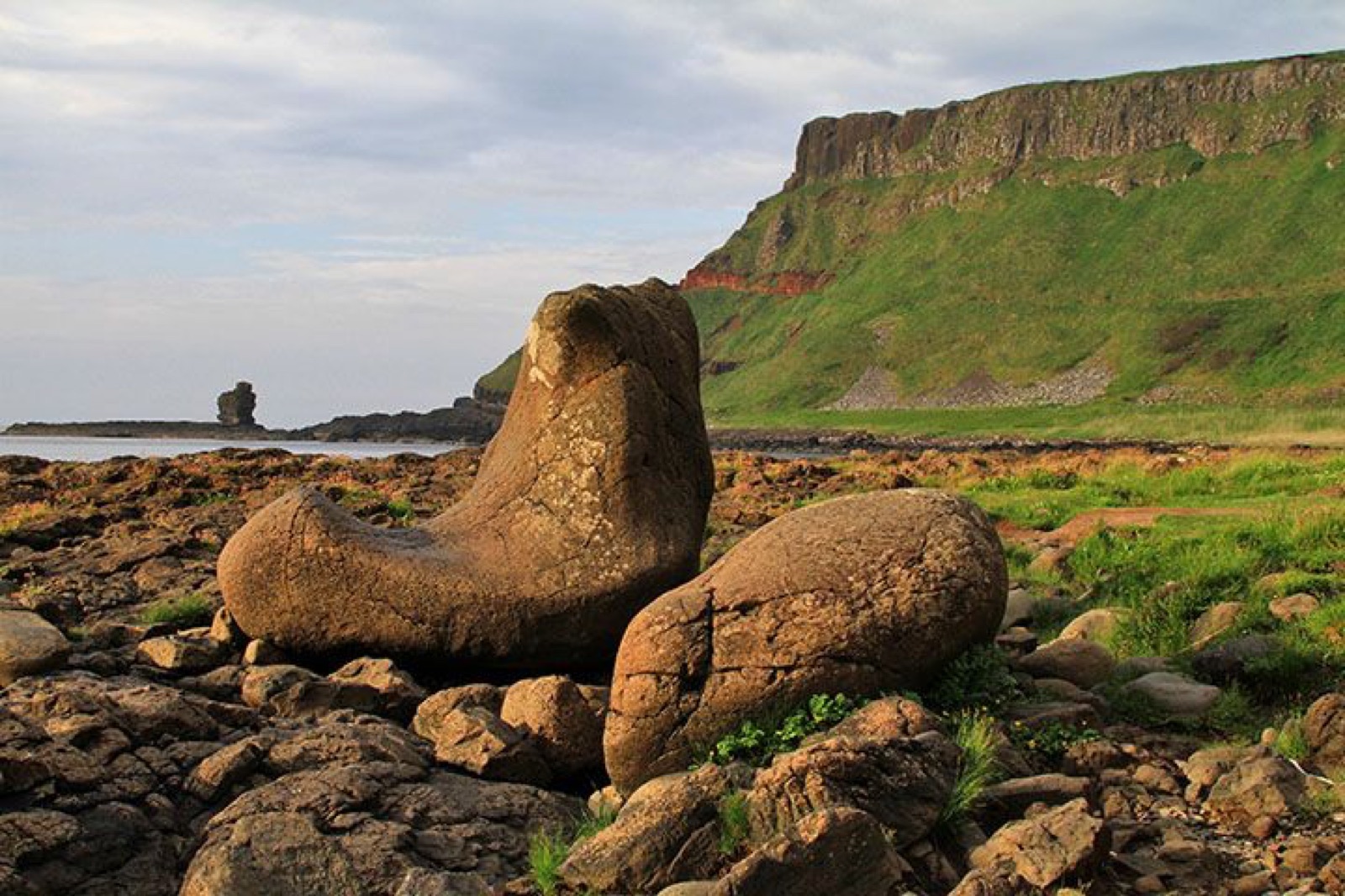
Local tradition points to several “petrified” features around the Causeway as remnants of the tale — the Giant’s Boot, the Wishing Chair, the Camel, the Giant’s Granny, and the Organ among them, each a naturally formed rock feature that’s picked up a story of its own over the centuries.
Lough Neagh and the Isle of Man
The same rivalry with Benandonner turns up in another well-known Irish legend, away from the coast entirely. Furious during one of their earlier exchanges, Finn is said to have scooped up an enormous clod of earth to hurl across the sea at his rival — missed, and the clod landed in the middle of Ireland instead, leaving a hollow that filled with water to become Lough Neagh, the largest lake in Ireland or Britain. The earth itself, the story goes, is the Isle of Man. It’s the same mythology, the same characters, and the same instinct to explain a striking piece of real geography as evidence of a giant’s temper.
Whether you take Finn McCool as history, folklore, or a bit of both, the stories are as much a part of visiting the Causeway as the rocks themselves — and worth having in mind next time you’re picking your way across the stones.