
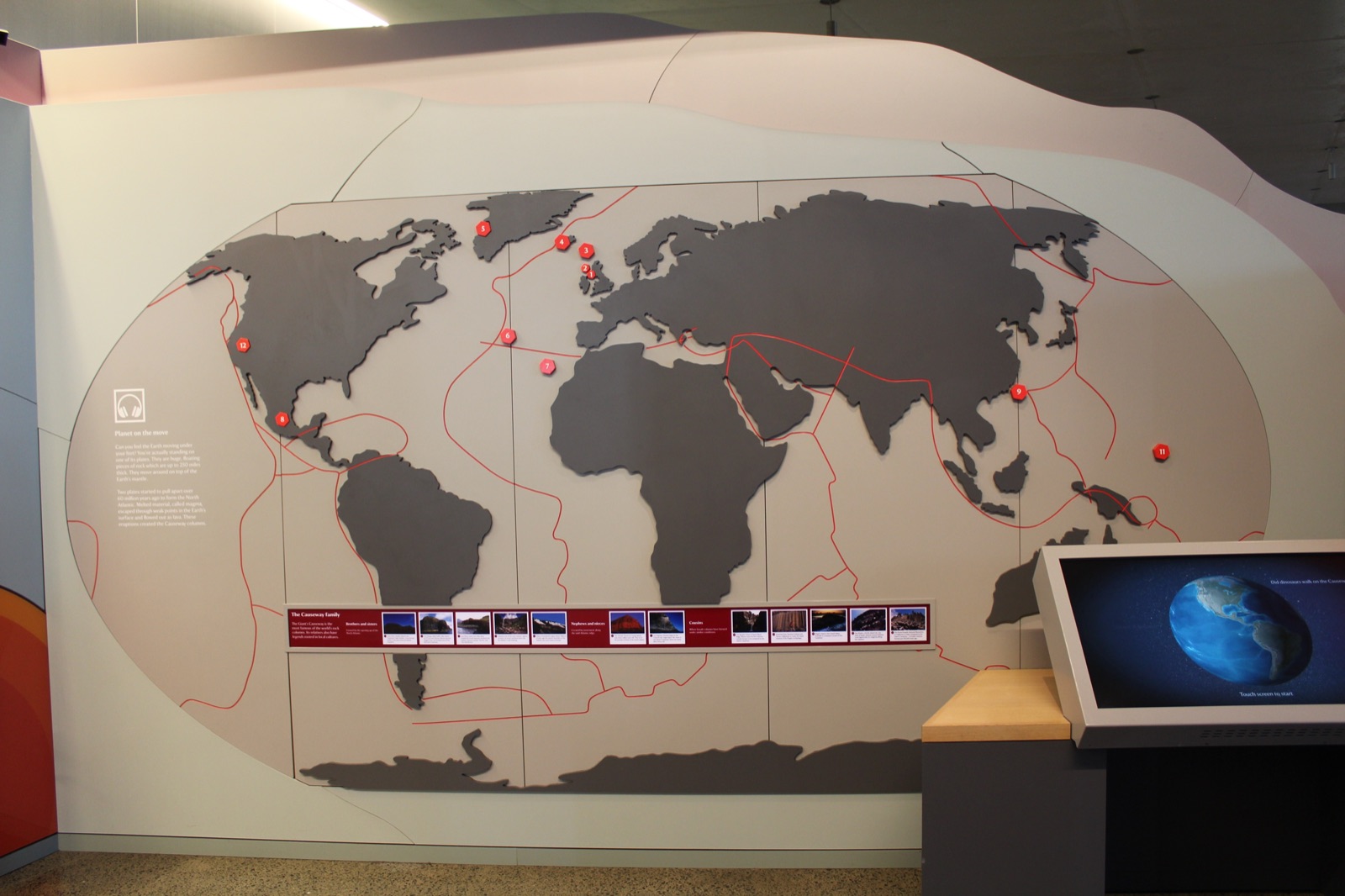
From eerie crater lakes to travertine terraces, the Earth has a knack for surreal landscapes — and some of the strangest are formed through volcanic processes. As basaltic lava cools, it contracts and cracks into remarkably geometric columns, a process called columnar jointing. It’s the same process that built the Giant’s Causeway — and it’s happened in a handful of other striking places around the world.
Fingal’s Cave, Staffa, Scotland
Just across the water from the Giant’s Causeway, and visible on a clear day, Fingal’s Cave sits on the Isle of Staffa off Scotland’s west coast — formed by the same lava flow that created the Causeway, around 50–60 million years ago. The name “Fingal” comes from the Irish “Fionn” (Finn McCool), and in legend the cave is the Scottish end of the very causeway Finn is said to have built to fight the giant Benandonner — see our myths and legends page for the full story.
Fingal Head, New South Wales, Australia
On Australia’s north coast, Fingal Head Headland features striking hexagonal basalt columns formed by the same rapid-cooling volcanic process — smaller in scale than the Causeway, but a genuinely impressive sight, set against dramatic coastal cliffs. (Thanks to Brent from brownsigns.net.au for pointing this one out to us.)
The Hexagon Pool, Israel
Known locally as Breichat HaMeshushim, this hexagon-columned pool sits at the bottom of a conserved-forest canyon in northern Israel, a popular swimming and hiking destination. The pool formed as water flowed over cooled igneous rock, and the hike in is reportedly a little treacherous in places — but worth it for the views.
Svartifoss, Iceland
In Vatnajökull National Park, Svartifoss (“Black Falls”) tumbles over dark basalt columns. Iceland’s volcanic geology means columnar basalt shows up in several places across the island, each one distinct.
Devils Postpile, California
Described by the US National Park Service as one of the finest examples of columnar basalt in the world. The formation reaches around 60 feet high, formed when a lava flow was dammed into a lake that cooled and cracked into its now-famous symmetrical columns.
Takachiho Gorge, Japan
Columns here rise more than 300 feet, with the Manai Falls continuously eroding the rock below — a genuinely dramatic green gorge, with plants growing directly on the wet columns.
Cape Stolbchaty, Kunashir Island, Russia
Basalt columns along the coast of the Kuril Islands, estimated at around 50 million years old — roughly the same age as the Causeway — and, like the Causeway, protected for their geological significance.
Jusangjeolli Cliffs, Jeju Island, South Korea
Massive basalt pillars formed over 100,000 years ago on this volcanic island, considered among the most striking cliff formations in South Korea.
Los Prismas Basálticos, Hidalgo, Mexico
A gorge lined with columnar basalt, with a waterfall running directly over the rocks — visitors can climb among the “steps” the flowing water has carved.
Los Órganos, Canary Islands, Spain
Named for their resemblance to organ pipes, these columns rise around 2,000 feet — a genuine geological spectacle on the Canary Islands’ coast.
Reynisfjara Beach, Vík, Iceland
Below Reynisfjall Mountain, at the back of Iceland’s famous black sand beach, columns rise to around 66 metres. The nearby sea stacks, Reynisdrangar, have their own troll legend — much like the Causeway has Finn McCool.
Wherever you find columnar basalt, you tend to find a legend to go with it. It’s a small world of very similar rocks, told through very different stories.