
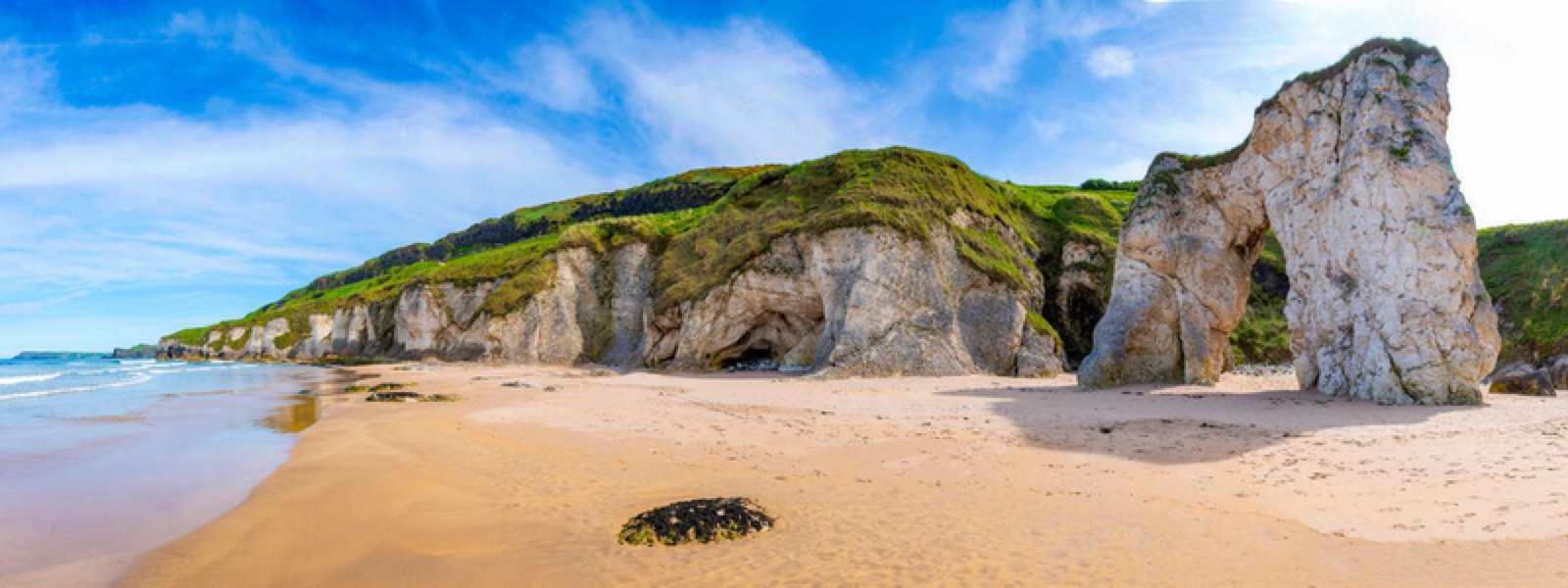
Between Portrush and Dunluce Castle, Whiterocks Beach is where the coastline briefly turns white — a run of chalk cliffs standing out sharply against the dark basalt everywhere else on this stretch. If you’re wondering why: see our geology page for the full explanation of the Cretaceous chalk beds beneath the Antrim basalts, visible here and nowhere else nearby in the same way.
The formations
Centuries of wave action have carved the soft chalk into a genuine run of named arches, headlands, and caves, rising straight out of the sea:
- The Wishing Arch and Elephant Rock — two of the most photographed formations on the beach, each named for an obvious resemblance once you see it
- Shelagh’s Head and the Lion’s Paw — distinctive headland shapes further along
- Cathedral Cave — the most impressive of the sea caves, with three separate arches
- Heart Cave and Teardrop Cave — smaller, named for their shape
Many of these caves are only reachable from the sea, and some are tidal — check tide times carefully before trying to explore further than the main beach, since getting cut off by an incoming tide along this stretch is a genuine risk, not a theoretical one.
Wildlife
The caves and arches aren’t just scenic — they’re a real hunting ground for seabirds and raptors, which makes this stretch ecologically important as well as photogenic.
Visiting
Whiterocks is a proper sandy beach in its own right, not just a backdrop — popular for walking, and increasingly for surfing, alongside Portrush’s other beaches (see our Portrush page for the full rundown of West Strand and East Strand). It’s an easy stop between Portrush and Dunluce Castle, on the same road either way you’re travelling.