
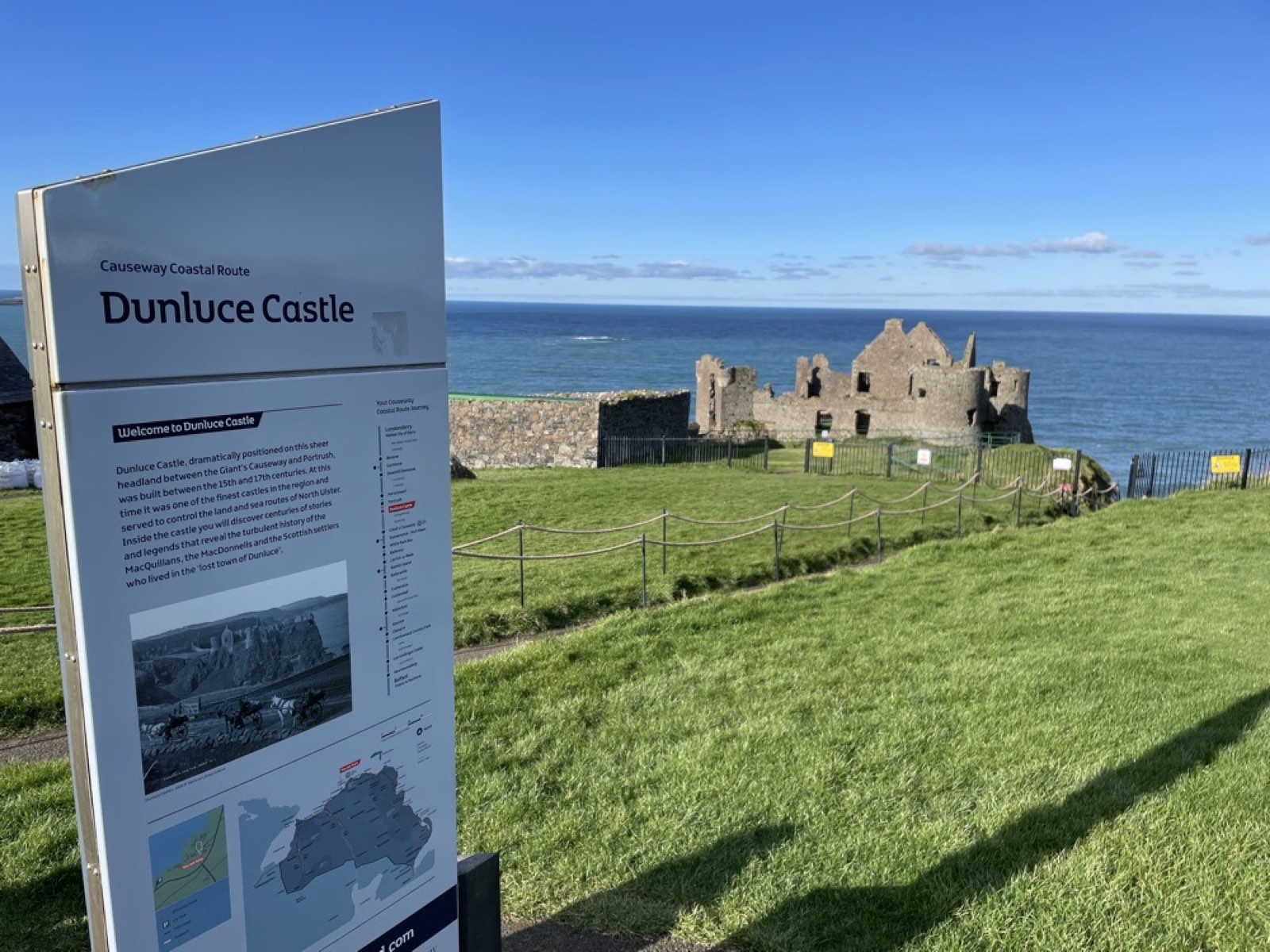
Perched on a sheer basalt outcrop between the Giant’s Causeway and Portrush, Dunluce Castle is one of the most photographed ruins on the Causeway Coast — and one of the closest to the Causeway itself. You’ll already have seen it from a distance if you’ve stayed at the Causeway Hotel or walked Whiterocks Beach; it’s worth the short trip to see up close.
History
The castle stands on a site occupied since at least the 1400s. The MacQuillan family, originally from Scotland, held the headland first, before the MacDonnells — another Ulster clan with strong Scottish ties — defeated them in battle in 1580 and took the castle. Sorley Boy MacDonnell then held it, lost it briefly to the Lord Deputy Sir John Perrot in 1584, and had it restored to him by Queen Elizabeth I two years later.
In 1588, a ship from the Spanish Armada — the Girona — wrecked on the rocks just offshore in a storm. According to local accounts, Sir James MacDonnell salvaged two cannons from the wreck and mounted them on the castle’s gatehouse, funding further building work with the proceeds of the recovered cargo.
The kitchen that fell into the sea
The castle’s best-known story: part of the kitchen wing collapsed into the sea below, taking most of the kitchen staff with it, after which Sorley Boy’s family reportedly refused to live so close to the cliff edge again. It’s a genuinely dramatic tale — but worth knowing that historians and archaeologists have found the picture murkier than the popular version suggests. Sources disagree on the exact date (commonly given as 1639, though some place it earlier), and excavations have found the kitchen itself largely intact rather than lost to the sea — suggesting the story may have grown in the telling over the centuries. Either way, the castle was abandoned not long after, and by the early 1700s the roof had gone and the site was left to the weather.
The lost town beside the castle
What most visitors miss entirely: Dunluce wasn’t just a castle. In 1608, Randal MacDonnell, the first Earl of Antrim, built a proper planned town on the land beside it — cobbled streets, a market place, houses for a mixed population of native Ulster Irish and Scottish settlers that had grown to around 300 people by 1620. It didn’t last. Irish rebels attacked in 1642, the castle itself was seized the same year, and although settlers tried to rebuild, the town never recovered and was abandoned by 1680. Over the next two centuries the streets and houses were slowly buried and grassed over — by the 1860s there was nothing left to see above ground.
Archaeologists only started properly excavating the site in 2014, and they’re still finding things: coins, clay pipes, glass beads, a merchant’s seal, blacksmith’s tools left exactly where they were abandoned. There’s genuinely no visible trace of any of this from the castle itself — worth knowing before you go, since it’s easy to stand on the headland and assume the ruin is all there ever was.
Game of Thrones
Dunluce provided the exterior of Pyke, seat of House Greyjoy on the Iron Islands, in Season 2 — the scene where Theon Greyjoy returns home to ask his father Balon for support in the war. If you’ve seen the show, the castle’s isolated, wind-battered position on the cliff makes total sense as a stand-in for the Iron Islands.
Visiting
Dunluce is managed separately from the Giant’s Causeway Visitor Centre and Causeway Hotel — it’s looked after by the Historic Environment Division (Department for Communities), not the National Trust, so a National Trust membership won’t get you in free here. There’s a small visitor centre, paid admission, and limited accessibility for wheelchair users given the uneven, exposed terrain. Dogs aren’t permitted except guide and assistance dogs.
Opening hours and admission prices change seasonally — check nidirect.gov.uk’s Dunluce Castle page or call 028 2073 1938 before you travel, rather than relying on a fixed time here.
Getting there: Dunluce sits right on the Causeway Coastal Route between Bushmills/Portballintrae and Portrush — easily folded into the same trip as the Causeway itself, whichever direction you’re travelling.