
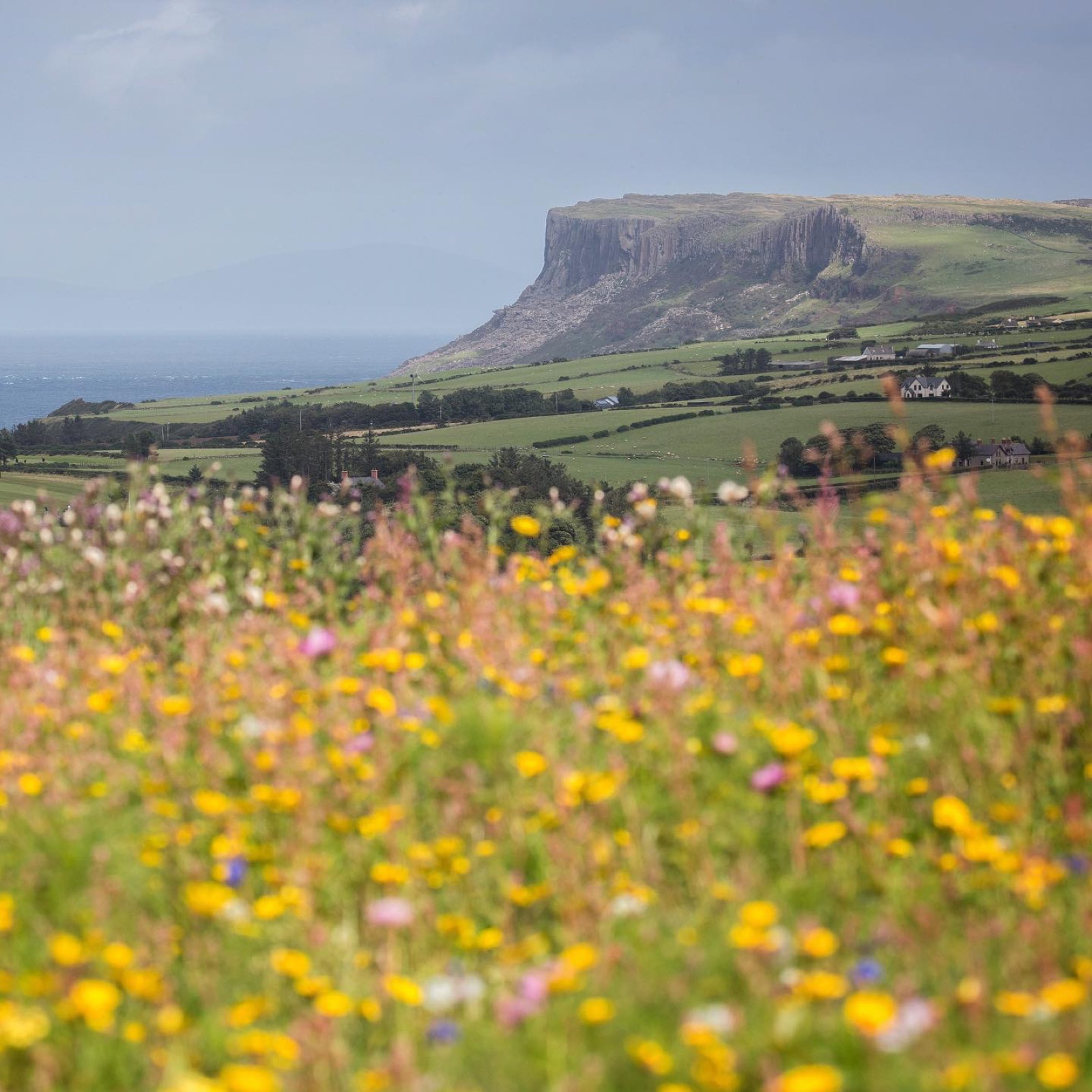
Fair Head — Benmore, or An Bhinn Mhór, “the great cliff,” in Irish — is the dramatic headland that dominates the view east of Ballycastle. It’s genuinely on a different scale to most of what else is on this coast: a five-kilometre (three-mile), 200-metre-high wall of rock facing the sea.
The cliff
Fair Head is made of dolerite, a tougher volcanic rock than the basalt at the Giant’s Causeway itself, and it’s regarded as one of the best rock-climbing destinations in Ireland — some climbers rank it among the biggest expanses of climbable rock anywhere in northwest Europe. You don’t need to climb it to appreciate the scale; the clifftop walk alone gives some of the most dramatic views on this whole stretch of coast, out toward Rathlin Island and, on a clear day, Scotland.
Lough na Cranagh
On the summit sit several small loughs, the best known of which — Lough na Cranagh — holds a genuine Iron Age crannog: a man-made island built for defence, with circular stone walls still standing 3-4 feet above the water in places. Sources differ on exactly how old it is — estimates range from the Iron Age to the Early Christian period — but crannogs across Ireland were built and used from the Late Bronze Age right through to the Middle Ages, serving as everything from defensive refuges to royal residences.
Visiting
Fair Head is a genuine walk, not a drive-up viewpoint — the AllTrails circular route covers the clifftop and Lough na Cranagh in one loop. Sturdy footwear and a reasonable level of fitness are worth having; this isn’t a paved path.
Getting there: signposted from Ballycastle, a short drive east of the town — easy to combine with Murlough Bay, which sits just below Fair Head on the same headland.