
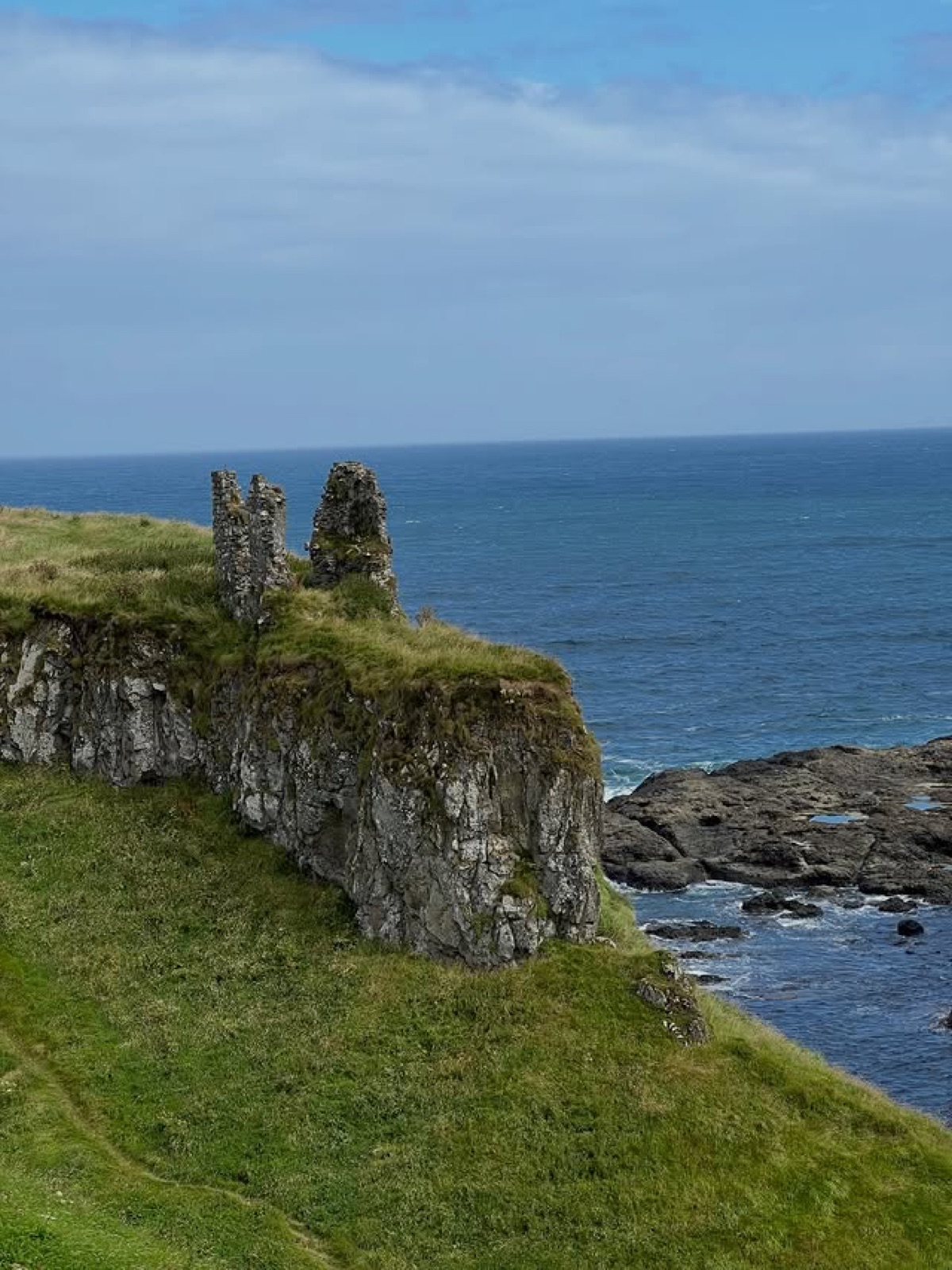
A few miles east of the Giant’s Causeway along the coastal path, Dunseverick is easy to underrate — what’s left is a modest ruin on a rock, nothing like the scale of Dunluce. Its real significance is almost entirely historical rather than visual, and it goes back much further than anything else on this stretch of coast.
History
The site is recorded in the Irish annals as Dún Sobhairce, named for Sobhairce, the chieftain said to have raised a fort here around the 5th century — making it, by tradition, one of the oldest named strongholds in Ireland. It later became the seat of Fergus Mór mac Eirc, a king of the Dál Riata kingdom that linked northeast Ireland and western Scotland — the same Fergus Mór traditionally credited as a founding figure of what became the Kingdom of Scotland.
Dunseverick was the northern end of Slige Midluachra, one of the five great royal roads said to run from Tara, seat of the High Kings of Ireland — real evidence of how significant this spot was in early Irish history, whatever the modest ruin suggests today.
Saint Patrick is said to have visited in the 5th century, baptising a local man named Olcán who went on to become a bishop. An oval depression of wet ground on the site’s northern side is traditionally identified as a holy well connected to the visit, known today as Saint Patrick’s Well.
The castle itself was held by the Ó Catháin family — a sept of the northern Uí Néill — from around 1000 AD, lost, then regained in the 16th century after the MacDonnells and Ó Catháin ousted the McQuillans (the same family that briefly held Dunluce Castle before the MacDonnells; see our Dunluce page). The site was attacked twice by Vikings, in 871 and 924 AD, and finally destroyed in 1642 during the Irish Confederate Wars by a Scottish Covenanter army under General Robert Munro, with further damage from Cromwellian troops soon after. The Ó Catháin name was later anglicised to O’Kane or McCain — a surname still common in this part of Antrim today.
The Falls
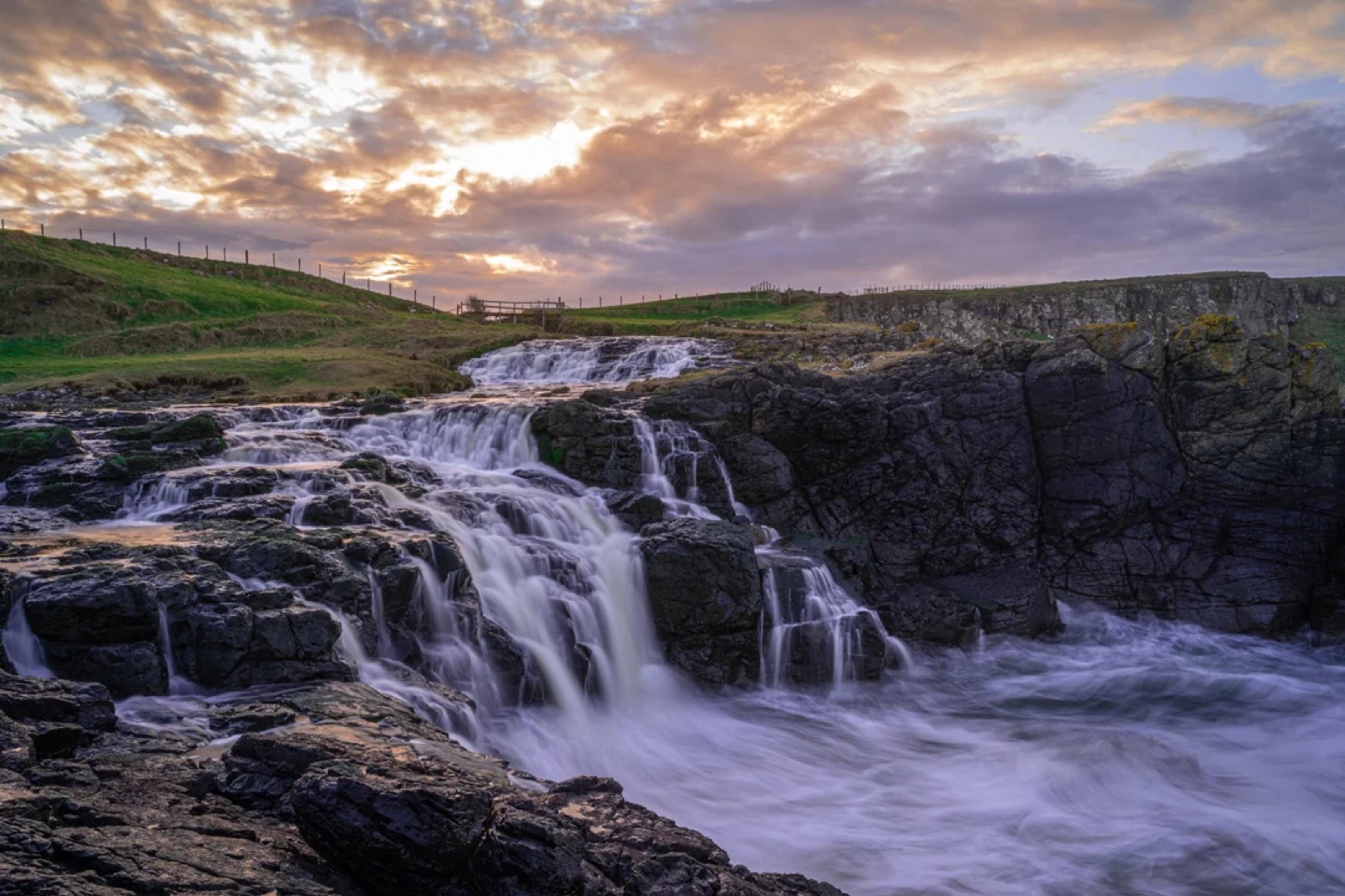
A waterfall drops down to the shore between the castle and Dunseverick Harbour, on the same short stretch of coastal path — worth building into the same stop rather than treating as a separate destination. The harbour itself is still used by local fishermen and makes a genuinely pleasant spot for a picnic.
Visiting
Dunseverick sits directly on the coastal path that runs from the Giant’s Causeway through Portbraddan and Whitepark Bay to Ballintoy Harbour — a proper walking route if you’d rather cover this stretch on foot than by car, and one we mention as a free parking alternative on our free visiting guide, since the small car park here is free (if not huge).
Getting there: take the B15 coast road toward Ballintoy; about 1.5 miles past the village, a signpost for the Giant’s Causeway directs you onto the B146, with a further signpost for Dunseverick Harbour.